
Gentle Health Disclaimer
The information shared on this Lifestyle page is intended for educational and inspirational purposes only. It is not a substitute for professional medical advice, diagnosis, or treatment. While healthy eating can play a valuable role in supporting the body and reducing inflammation, individual health needs and medical conditions vary. Always consult a qualified healthcare professional before making changes to your diet, lifestyle, or medication. Never stop or alter prescribed medication without guidance from your healthcare provider.
God did not design the body as something to battle, but as something to steward. Scripture reminds us that we are fearfully and wonderfully made, crafted with intention and care. When the body signals distress, it is not failing — it is responding exactly as it was designed to do.
Inflammation, then, can be seen not as punishment, but as a protective response — a reminder that something within us needs gentleness, wisdom, or rest.
Working with the body becomes an act of trust: trusting God’s design, trusting the processes He set in motion, and trusting that healing often unfolds through small, faithful choices rather than forceful control.
When we choose nourishment, rest, and patience, we are not striving for perfection — we are partnering with grace. And in that partnership, healing is no longer rushed or resisted, but received.
Sometimes, the most faithful response is simply to listen — and to care for what God has already so carefully made.
Inflammation is the body’s natural defence system, but when it sticks around for too long, it can start to show up as everyday niggles like low energy, aching joints, digestive discomfort, stubborn weight gain, and an increased risk of conditions such as heart disease and diabetes. The reassuring part? What you eat really can make a difference. Food has a powerful way of calming inflammation and supporting your body from the inside out. With simple, nourishing choices, you can help your body feel more balanced, energised, and at ease. This isn’t about strict rules or giving up the foods you love — it’s about tuning in, eating with intention, and creating habits that help you feel your best, day after day.
While anti‑inflammatory medications can be helpful and sometimes necessary, relying on them alone can mask symptoms rather than address what’s driving inflammation in the first place. Long‑term use may also come with unwanted side effects, which is why many people start looking for more supportive, sustainable solutions. Food, on the other hand, works with your body every day — nourishing, soothing, and supporting your natural healing processes. By gradually shifting your eating habits and making thoughtful food choices, you can help reduce inflammation at its roots. When done in partnership with your healthcare provider, this approach becomes a powerful complement to medical care, supporting your health in a way that feels proactive, empowering, and kind to your body over the long term.
🌱 7‑Day Anti‑Inflammatory Menu
Day 1
Day 2
Day 3
Day 4
Day 5
Day 6
Day 7
🌱 Vegetarian Anti‑Inflammatory 7‑Day Menu
Day 1
Day 2
Day 3
Day 4
Day 5
Day 6
Day 7
🌿Vegan Anti‑Inflammatory 7‑Day Menu
Day 1
Day 2
Day 3
Day 4
Day 5
Day 6
Day 7
Omega‑3: A Friendly Fat That Helps Calm Inflammation
When people hear the word inflammation, they often think of a swollen ankle or a sore joint. But inflammation can also be quieter and long‑lasting, showing up as ongoing joint pain, stiffness, fatigue, digestive issues, or chronic health conditions. The good news? What we eat can make a real difference — and omega‑3 fats are one of the most helpful nutrients when it comes to calming inflammation.
So, What Exactly Are Omega‑3s?
Omega‑3s are a type of healthy fat that our bodies need but can’t make on their own. That means we have to get them from food. You may have heard of them in connection with fish like salmon, but they also come from certain plant foods.
There are three main types:
EPA and DHA are the heavy lifters when it comes to fighting inflammation, but ALA still plays an important supporting role.
How Do Omega‑3s Help With Inflammation?
Think of inflammation like a fire in the body. Omega‑3s don’t just mask the symptoms — they help turn down the heat.
They do this by:
Over time, this can mean less joint pain, less stiffness, and better overall comfort, especially for people dealing with chronic inflammation.
What Benefits Might People Notice?
Because inflammation affects so many systems in the body, omega‑3s can support health in several ways:
These benefits don’t usually happen overnight, but they add up with consistent intake.
Do You Have to Eat Salmon?
Not at all. While salmon is well known for its omega‑3 content, it’s not the only option — and it’s not affordable or appealing to everyone.
Other good fish options include sardines, pilchards, mackerel, and herring, which often provide similar benefits at a much lower cost.
For vegetarians (or those who don’t enjoy fish), omega‑3s can still be part of the picture:
The Take‑Home Message
Omega‑3s are a simple but powerful addition to an anti‑inflammatory lifestyle. Whether they come from affordable oily fish or from well‑chosen plant and algae sources, these healthy fats help the body move out of a constant “inflammatory state” and into better balance.
You don’t need perfection — just regular, intentional choices. A few small changes over time can make a noticeable difference in how the body feels.
When Dieting Stopped Working
For most of my life, I believed the only path to weight loss was to “go on a diet.” Strict rules, giving things up, feeling guilty when I slipped, and promising myself I’d start again on Monday. Even when I tried to eat “healthy,” I found myself constantly hungry, craving snacks, and feeling frustrated by a scale that seemed permanently stuck.
Then came a quiet suspicion: Maybe I was insulin resistant
Something wasn’t adding up.
Discovering Intermittent Fasting — And Why It Felt Surprisingly Natural
I approached intermittent fasting (IF) with hesitation. I expected it to feel restrictive or difficult. Instead, something surprising happened:
It felt easier than “normal” eating.
Giving my body longer breaks between meals calmed everything.
My hunger signals softened.
My cravings faded.
And for the first time in ages, I didn’t feel like I was fighting with myself.
I realized that once I started eating proper, nourishing food, my body stopped
screaming for snacks all day.
The Gentle Shift: Losing Weight Slowly, Consistently, and Calmly
Before IF, the scale either didn’t move or moved in the wrong direction. Now, it was finally moving downward in small but reliable steps. The yo‑yo pattern settled. My body felt like it had finally found its rhythm.
The numbers moved down in small, steady steps.
Not overnight.
Not dramatically.
But reliably.
It was the kind of progress that felt real and sustainable instead of exhausting or fragile.
How Healthy Cheats Helped Me Stay Sane
I’ve never believed in cutting out everything I enjoy — it’s the fastest route to frustration and giving up. Instead, I found healthier cheats that satisfied cravings without sabotaging my progress:
• dark chocolate instead of milk chocolate
• air‑popped popcorn instead of chips
• oven-baked fries instead of deep‑fried ones
• smaller portions instead of elimination
Healthy cheats allowed me to enjoy food without guilt or obsession. They helped me stay grounded, normal, and emotionally balanced.
What a Simple Day of Eating Looks Like for Me
One major key to my success was simplifying my meals. Simplicity took away the ‘overwhelm’ and made consistency almost effortless.
10:00 — First Meal: A Nourishing Wrap
I break my fast with a wrap — flaxseed, sourdough, or stone-ground — filled with half of the chicken salad I make fresh each morning:
• chicken breast pieces
• lettuce
• red and yellow peppers
• raw garlic
• herbs
• canola/olive oil–based mayonnaise
Proper food.
Proper nourishment.
Proper satisfaction.
13:30 — Second Meal: The Rest of the Chicken Salad
Effortless, filling, satisfying. And because it’s real food, I don’t need snacks between meals.
17:30 = 18:00 — Dinner: Simple, Clean, Uncomplicated
I grill chicken breast (mostly chicken schnitzel to make it even tastier) and pair it with steamed or air-fried vegetables.
Simple works for me.
Simple keeps me grounded.
Simple keeps me on track.
Water: The Quiet Hero Behind My Progress
In my blog Let Food be thy Medicine, I wrote that water is the unsung hero of health — and I feel that even more strongly now.
Water quietly steadies everything:
reduces false hunger
calms cravings
supports digestion
stabilizes energy
enhances fasting
Chocolate may be the diva…
but water is the true star of the show.
Every glass feels like I’m giving my body a small gift — simple, supportive, and grounding.
What Intermittent Fasting Taught Me About Myself
Through this journey, I discovered lessons I never expected:
Hunger isn’t an emergency. I learned to distinguish real hunger from habit hunger.
Proper meals beat constant snacking. My body thrives on real food.
Simplicity is sustainable. Meal overwhelm is gone.
Consistency matters more than perfection. Slow, steady progress are better than quick fixes.
Food isn’t the enemy. My mindset was the problem.
My body likes space. Resting between meals calmed everything.
Water is my superpower. Quiet, simple, essential.
I am stronger than I thought. IF showed me my own capability.
I learned that my body wasn’t broken — it was confused, overloaded, and trying to communicate with me. IF helped me hear it.
Choosing Kindness Over Perfection
Intermittent fasting didn’t just reshape my eating — it reshaped my relationship with myself.
I no longer chase diets.
I no longer fear food.
I no longer fight constant hunger.
Instead, I’ve found peace in routine, pride in progress, joy in simplicity, and trust in my body’s own wisdom.
This journey taught me that transformation doesn’t always roar. Sometimes it arrives gently — through slow weight loss, calmer hunger, clearer signals, and a growing sense of inner steadiness.
IF didn’t give me a new body.
It gave me a new relationship with my body.
And that is something I will carry with me for the rest of my life.
✨ My Intermittent Fasting Daily Menu ✨
Eating Window: 10:00 AM – 6:00 PM
🍽️ 10:00 – Meal 1: Nourishing Chicken Salad Wrap
Choose your wrap:
• Flaxseed wrap
• Stone‑ground wrap
• Sourdough wrap
Chicken salad filling:
• Cooked chicken breast pieces
• Lettuce
• Yellow & red peppers
• Raw garlic (finely chopped)
• Fresh herbs
• Canola/olive‑oil‑based mayonnaise
👉 Make enough for two meals. Half goes into your wrap
🥗 13:30 – Meal 2: Second Serving of Chicken Salad
• The second half of your homemade chicken salad
• No prep, no fuss — just real food
• Keeps you full and helps stabilise hunger
🍗 17:30–18:00 PM – Meal 3: Simple & Satisfying Dinner
Protein:
• Grilled chicken breast
Vegetables (choose 1–2):
• Steamed vegetables
• OR air‑fried vegetables (baby marrow, carrots, broccoli, etc.)
👉 I keep dinner plain and simple so that it never feels overwhelming.
🛒 Shopping List (Organised for Quick and Easy Shopping)
🥬 Fresh Produce
• Lettuce
• Yellow peppers
• Red peppers
• Raw garlic
• Baby marrow (optional)
• Broccoli
• Carrots
• Fresh herbs (parsley, coriander, or basil)
🍗 Proteins
• Chicken breasts / Chicken Schnitzel (buy enough for 2–3 days at a time)
🥖 Wraps & Pantry Staples
• Flaxseed wraps
• Stone‑ground wraps
• Sourdough wraps
• Canola/olive-oil mayonnaise
• Olive oil (if needed for cooking)
🌿 Seasoning & Extras (if needed)
• I find that the raw garlic adds a lot of flavour but use any herbs or spices that you like

In the Beginning: God’s Original Plan
When we look at Scripture, we find that God’s first provision for human nourishment was simple and pure. In Genesis 1:29, God said:
“I give you every seed-bearing plant on the face of the whole earth and every tree that has fruit with seed in it. They will be yours for food.”

The Shift After the Flood
Things changed after the flood. In Genesis 9:3, when Noah stepped out of the ark, God declared:
“Everything that lives and moves about will be food for you. Just as I gave you the green plants, I now give you everything.”
This marked a significant shift. Animal protein became part of the human diet. Why? Perhaps because the earth had been devastated by the flood, and plant life was scarce. Or maybe it was part of God’s plan for a fallen world. Whatever the reason, it reminds us that food choices have always been connected to seasons, circumstances, and God’s provision.
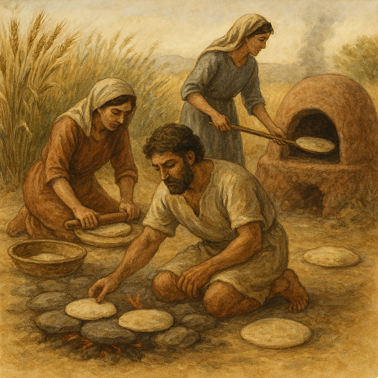
Faith and Food: A Spiritual Perspective
Food is more than fuel—it’s a reminder of God’s goodness. Every bite can be an act of gratitude. And just as physical nourishment sustains life, spiritual nourishment sustains the soul. Jesus said in John 6:35:
“I am the bread of life. Whoever comes to me will never go hungry, and whoever believes in me will never be thirsty.”
Our ultimate satisfaction isn’t found in what’s on our plate, but in Him.
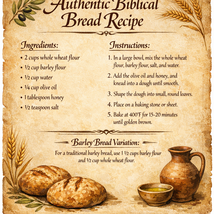
WHAT KIND OF BREAD DID JESUS EAT?
Ingredients: Whole grain flour, water, salt, sometimes olive oil or honey.
Cooking Method: Baked on hot stones, in clay ovens (tabuns), or over an open fire.
Occasional Additions: Herbs like coriander or fennel seeds for flavor. [recipestheir.com]
FLOUR IN FIRST-CENTURY ISRAEL
In biblical times, bread was a daily staple — but the type of flour used often reflected one’s social standing:
Wheat, Spelt, and Emmer: Finer grains, typically reserved for wealthier households.
Barley: A humbler grain, widely eaten by poorer families and mentioned in Scripture — such as the boy with five barley loaves in John 6:9. Coarser and less refined, barley bread sustained many through seasons of scarcity.
Wheat
Spelt (kussemeth) was one of the grains listed in Ezekiel 4:9, used in times of scarcity and survival. Its nutty flavour and hearty texture made it a staple in ancient Israel, especially among those who lived simply and close to the land.